

A detector spec sheet can look like a wall of numbers. Most of them matter less than you would think. Four choices decide almost everything about how a detector feels on a Saturday morning: the size and shape of the coil, the modes you will actually use, which parts can get wet, and what keeps it powered. This guide takes them one at a time, with our own models as examples, and says plainly where another kind of detector would serve you better.
Start with where you will hunt
Before any spec, picture the ground. A town park full of bottle caps calls for a different tool than an open beach or a plowed field. Write down the two places you will visit most often. Every choice below gets easier once you know them.
| Where you hunt most | What matters most | A SUNPOW place to start |
|---|---|---|
| Parks and lawns | A smaller, lighter coil and good discrimination | 8 in rechargeable, 20 h |
| Dry and wet sand | A sealed coil and a bigger sweep | 11 in Double D, rechargeable |
| Creeks and tide pools | A sealed coil and a waterproof pinpointer | 10 in coil with ground balance |
| Fields and trails | Ground balance and battery life | 10 in coil with ground balance |
| The back yard with kids | Weight, stem length, one or three buttons | MD20 kids detector |
Coil size: coverage against control
The search coil is the round or oval loop at the bottom of the stem. It sends a signal into the ground and listens for metal. Its size shapes two things you will feel at once: how much ground each sweep covers, and how easily the detector separates two targets lying close together.
A bigger coil covers more ground per pass, which is what you want on an open beach or a field. It is also heavier at the end of a long stem, and in a park full of trash it will often hear a coin and a pull tab at the same time. A smaller coil is lighter, easier to steer around benches and trees, and better at picking one target out of a cluster.
Across our range, coils run from 6 in on the MD20 kids detector to 12 in on the MD14 in our detector and pinpointer set. The 8 in coil on our 20-hour rechargeable model is the middle ground most first-time hunters settle on.
Round coil or Double D
Coils also differ in how the windings inside are laid out. A round coil (often called concentric) detects in a cone under its center. A Double D coil has two overlapping D-shaped windings and detects in a blade-shaped strip from front to back. In practice, a DD coil tends to cope better with wet sand and mineral-rich ground, and it covers a wider strip per sweep. Our 11 in rechargeable detector uses a Double D coil for exactly that reason.
Modes you will actually use
Most detectors offer more modes than you need. On our detectors, four cover nearly every hunt.
- All Metal sounds off on everything, iron included. Use it to learn a new site and to dig everything on a clean beach.
- DISC (discrimination) ignores the metals you tell it to, usually iron and foil. Use it in trashy parks.
- Notch skips one band of targets and keeps the rest, which is handy when a site is full of one kind of junk, such as pull tabs.
- Pinpoint narrows the signal to the spot under the coil's center, so you can cut a smaller plug.
Some of our detectors add a Memory mode that keeps your settings between hunts, or a Jewelry mode tuned to small gold and silver. They are useful, but they will not decide whether you enjoy the hobby. Learn All Metal and DISC first.
One honest limit: no setting makes a detector certain about every target. Foil and pull tabs can sound close to a small gold ring. On a clean beach, many experienced hunters dig every solid signal for that reason.
The display and target ID
Most detectors today show a number or an icon for each signal, often called target ID. It is the detector's best guess at what kind of metal lies under the coil, based on how the target responds to the signal. Iron reads low, silver and copper read high, and gold, foil and pull tabs land somewhere in the middle.
Treat target ID as a hint, not a verdict. Depth, the angle of the target and nearby trash all shift the reading. Watch whether the number holds steady as you sweep from different directions. A steady reading is worth digging, a jumpy one is often trash or two targets close together. Our backlit displays also show depth and battery level, so you know how far down to dig and when to charge.
Ground balance in plain words
Soil is not neutral. Some ground holds iron minerals, and wet beach sand holds salt. Both can make a detector sound off when nothing is there. Ground balance tells the detector to ignore the ground itself and listen only for metal in it.
Many entry detectors set ground balance at the factory and leave it fixed, which is fine for parks and dry sand. On mineral-rich ground, a detector you can balance yourself runs quieter and finds more. Our 10 in model lets you adjust ground balance in All Metal mode, which suits fields, trails and creek beds with dark, heavy soil.
Waterproofing: read the IP code
The word waterproof on its own tells you little. The IP code, defined in the international standard IEC 60529, is more useful. It has two digits. The International Electrotechnical Commission explains the first:
“The first numeral refers to the protection against solid objects and is rated on a scale from 0 (no protection) to 6 (no ingress of dust).”
The second digit covers water. A 7 means the part survived temporary immersion in a test tank. An 8 means more: the standard's own contents list describes the test for it this way:
“Test for second characteristic numeral 8: continuous immersion subject to agreement”
Subject to agreement means the depth and time behind an IP68 rating are stated product by product, so always read which part is rated and how deep. On every SUNPOW detector, the search coil is rated IP68 and the control box is not waterproof. You can sweep the surf line and the shallows. You should not dunk the box. On our GD02 rechargeable pinpointer, the whole wand is rated IP68 and stated for 10 ft of fresh water.
| IP code | What it means | Where you will see it |
|---|---|---|
| IPX7 | Temporary immersion between 0.15 m and 1 m (about 6 in to 3.3 ft). Dust not rated | Some pinpointers and phones |
| IP68 | Dust-tight, and continuous immersion on terms stated for the product | SUNPOW search coils and pinpointer wands |
| No rating on the box | Keep it dry | Most detector control boxes at this level, ours included |
If you want to put the whole detector under water, control box and all, a fully submersible model is the better buy. For beach and creek work with the box held high, a sealed coil is enough.
Power: 9V, AA or a built-in battery
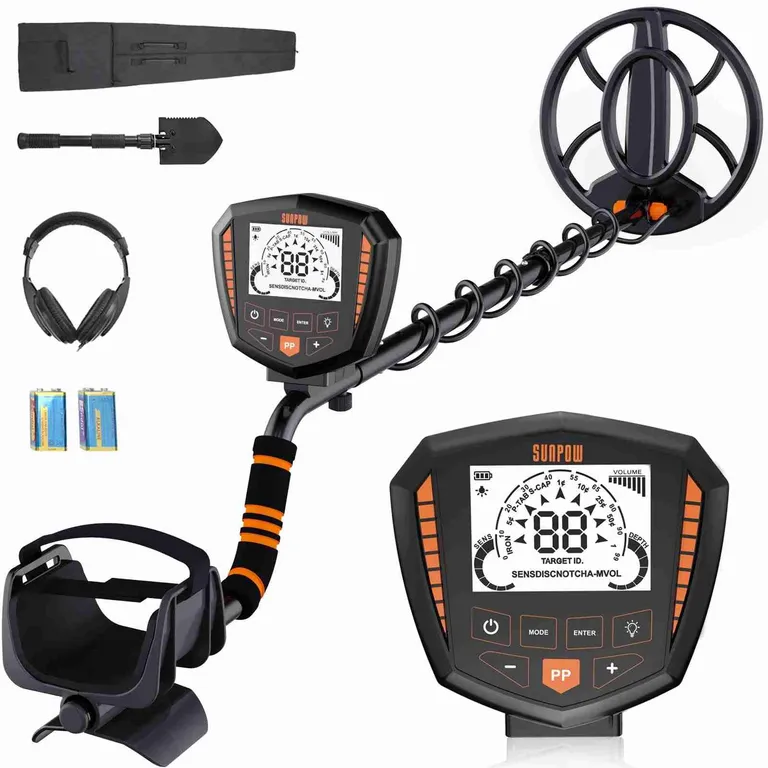
Older and simpler detectors run on 9V or AA batteries. That has one real advantage: spares are sold everywhere, and you can swap them on the beach. The downside is cost over a season and the odd hunt cut short by a dead battery you forgot to replace.
Our newer detectors carry built-in lithium batteries that charge over USB-C or Type-C, like a phone. The 8 in model runs 20 hours or more on 1500 mAh. The OTMD15 version of our 11 in DD detector runs up to 35 hours on 2500 mAh. That is several weekends between charges for most people. Our kids' detectors stay on a single 9V, which keeps them light and cheap to run.
Weight, stem length and comfort
A detector that hurts after an hour will stay in the closet. Check the stem range against the height of whoever will use it. The coil should hover just above the ground with the arm relaxed and the elbow slightly bent. Our adult stems run from about 41 to 55 in depending on model, and the MD14 in our set reaches from 19 to 59 in.
Headphones help more than most beginners expect. They block wind and traffic noise, keep the beeps from annoying people around you, and let you hear the faint signals from deeper targets. Most of our adult detectors have a headphone jack, and some kits include a pair.
Choosing for a child
Children need a detector sized for them, not a cheaper adult one. Three things matter: weight, stem length and how many buttons there are to get wrong.
Our MD20 kids detector weighs 1.24 lb, has one button and a stem that sets from 23.6 to 27.5 in, which suits ages 6 to 12. The LCD kids model adds three modes for slightly older children and sets from 32 to 40 in. For a family that wants to share one unit, our 8 in family detector adjusts without tools from child height to adult height.
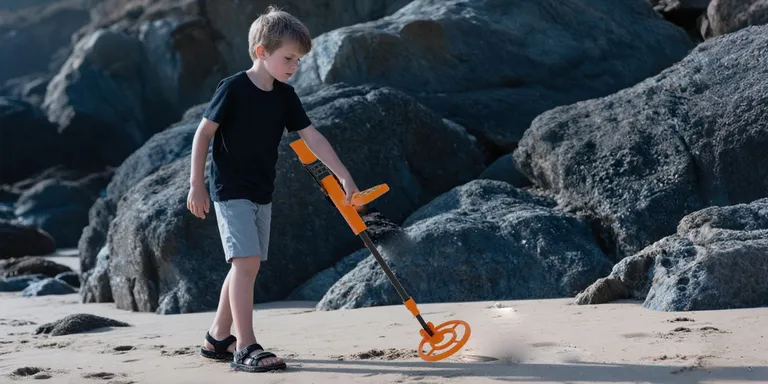
Keep the first hunts short, and bury a few coins in the yard beforehand so the first sweep ends in a find. Twenty minutes and a real coin will do more for a child's interest than an hour of silence.
Why a pinpointer pays off
You can dig without one. But the coil only narrows a target to a circle the width of the coil, and most of the time on a hunt goes into finding the target inside the hole. A pinpointer works in the hole itself, with an alert that speeds up as the tip gets closer. Every SUNPOW pinpointer scans 360° around the tip, so a coin sitting in the side wall still sounds off.
When another detector is the better choice
Our detectors are single-frequency machines with sealed coils, built for a first season and many after it. They are not the right tool for everything. If you hunt salt beaches every weekend, a multi-frequency detector handles the wet salt sand better. If you want to snorkel with your detector, buy one rated as fully submersible. If you prospect for small gold nuggets in heavily mineralized ground, look at detectors built for that job.
A short buying checklist
- Name the two places you will hunt most.
- Pick the coil size for those places: 8 in for parks, 10 to 12 in for open beaches and fields.
- Check which part is sealed, and how deep.
- Choose the power you prefer: AA or 9V for swapping, lithium for recharging.
- Check the stem length against the user's height.
- Budget for a pinpointer, headphones and a digger, or buy a set that includes them.
Then read the rules for your first spot, which we cover in our guide to where you can detect, and get out there.
Sources
- International Electrotechnical Commission (IEC), “Ingress Protection (IP) ratings”, read online, read October 28, 2026
- IEC 60529 (Degrees of protection provided by enclosures), official preview hosted by VDE Verlag, “IEC 60529:1989+A1:1999: preview pages (contents and scope)”, read online, read October 28, 2026
- Photo: SUNPOW image as published at sunpowdetector.com